How docopywritersstudy a market
- Tuhin Nair12 min read
What does an expert copywriter pay attention to? And how do they organize their observations?
To illustrate this skill, we'll follow an imaginary fork salesperson as they try to sell their forks from village to village.
§01
Selling forks to an inn that only serves soup
Our fork salesperson has just walked into an inn and noticed the inn serves only soup.
The forks, as it happens, are pretty useless for that kind of thing. But the salesperson needs the money now: they need money to spend the night in this town and then the next morning, they're to make their way on foot to the next village over.
It's clear they're in a bad position. In an ideal world, they'd only find people it was easy to sell to. But right now, they need to make a sale in a bad position just to continue their business.
§02
Ideal positioning is ideal but you work with the positioning you get
Many marketing books talk about the concept of positioning, and it's a popular and enduring concept because of how well it frames the idea of a marketing strategy. A good position is being simultaneously unique and valuable in a market. It's beautiful. It's the marketing holy grail.
It's also not always possible.
Or available as an option in the current moment. It would be great if we could always be in a good position in a market. But markets change, competitors change, technologies change. Sometimes you don't have the capabilities for a good position and sometimes you don't have the resources to capture a good position.
An expert copywriter deals with it.
Our fork salesperson is quite literally positioned to make no sales. An expert copywriter comes to terms with what they cannot control at that moment.
If they're stuck in a position, they let go of the ideal and look for options. To an expert copywriter, bad positioning is bad but it's not game over.
§03
Positioning is not just a metaphor, it's also literally about positions
'Positioning' is a metaphor that tries to capture your relationship with a buyer and your competition.
A spatial metaphor, to be precise. To find a good position is to be close to what a specific buyer wants and have no other competitors nearby. Likewise, to be in a bad position is to be far from what a specific buyer wants or to be entirely shrouded by your competition.
All that is awesome but copywriters don't just work metaphorically. They need some way of building, breaking apart, and tinkering with positioning.
Copywriters aren't psychologists or sociologists (at least not by requirement) and there is no real scientific theory you must champion to be a copywriter. But there's a core assumption behind every copywriter's work, even if it's very abstract: 'people use things for a purpose'.
The expert copywriter takes this a step further by wielding the most powerful tool they have: naming these things.
First, they name the purpose. This could be functional, outcome-based, emotional, whatever the copywriter thinks makes sense to focus on. The fact that there's choice in how a purpose is defined is a power that copywriters take advantage of. You can try different ways of defining a purpose and see how things change as a result of that.
For our fork salesperson, we could start like this:
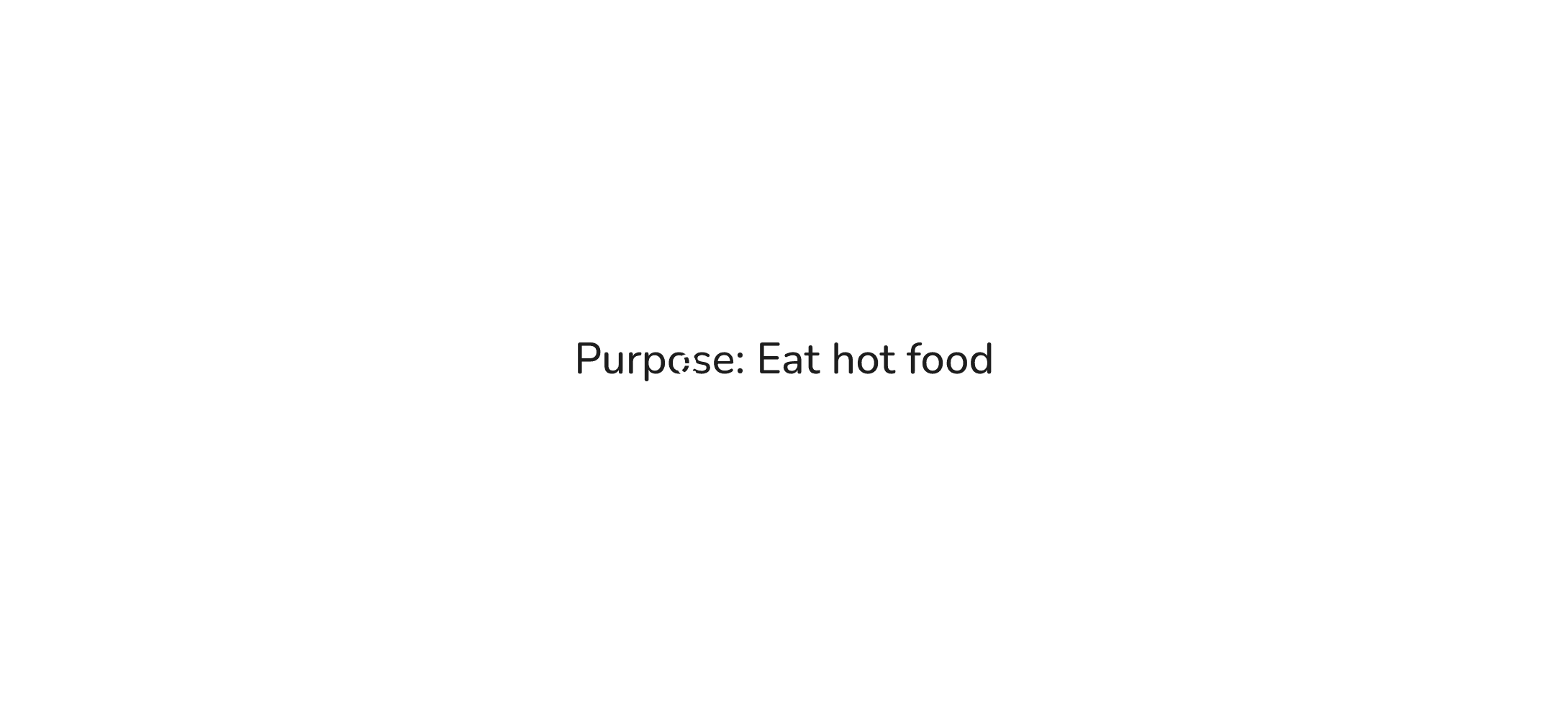
It's the most common purpose for forks, so it makes sense to start here. Then the expert copywriter observes the options the buyer has to fulfill the purpose and names them:
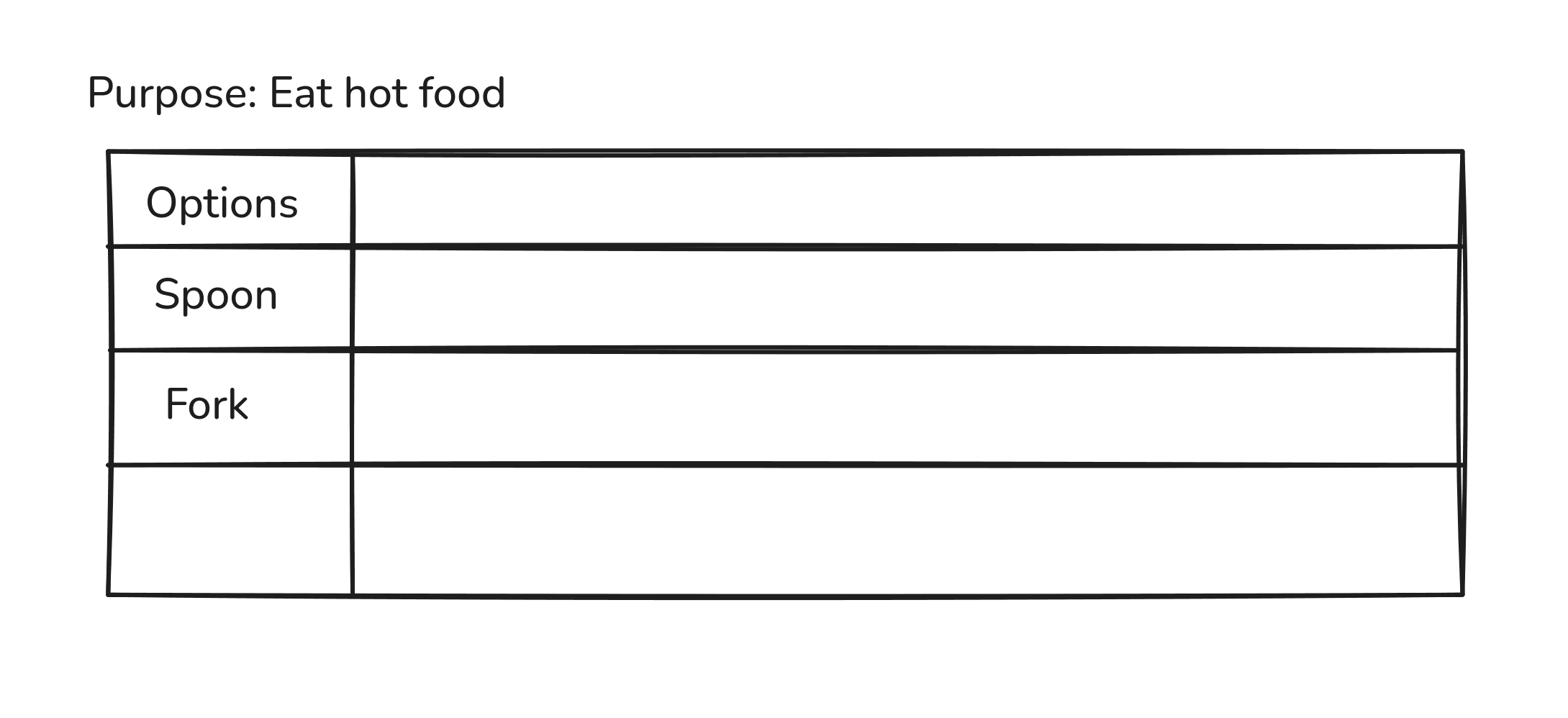
To an expert copywriter, an option is a set of relationships. Meaning, they're concerned with how an option affects a purpose in different ways. What this looks like is breaking down what you observe into multiple 'how' based relationships.
The expert copywriter now starts to pay attention to the options and tries to name the different purpose-related 'how' relationships they observe in each option:
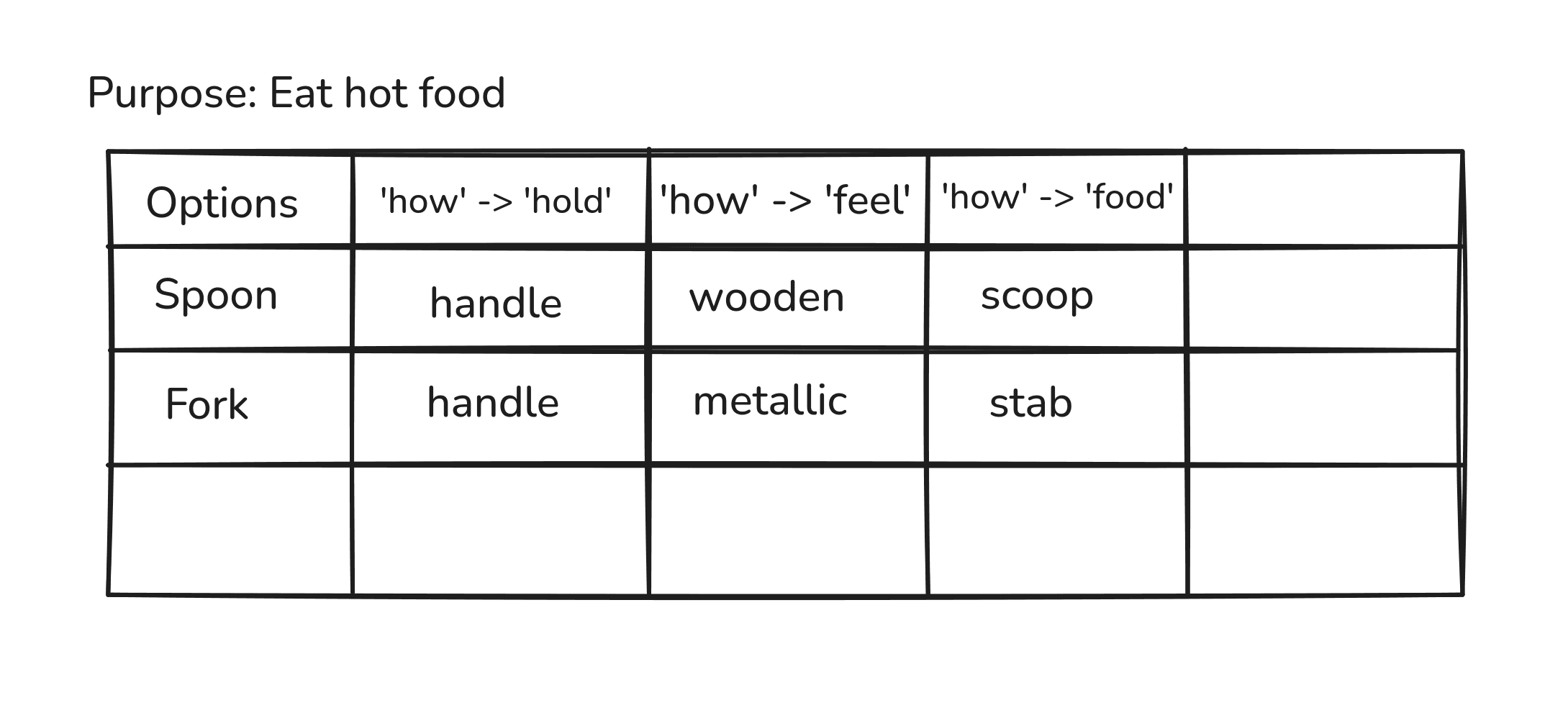
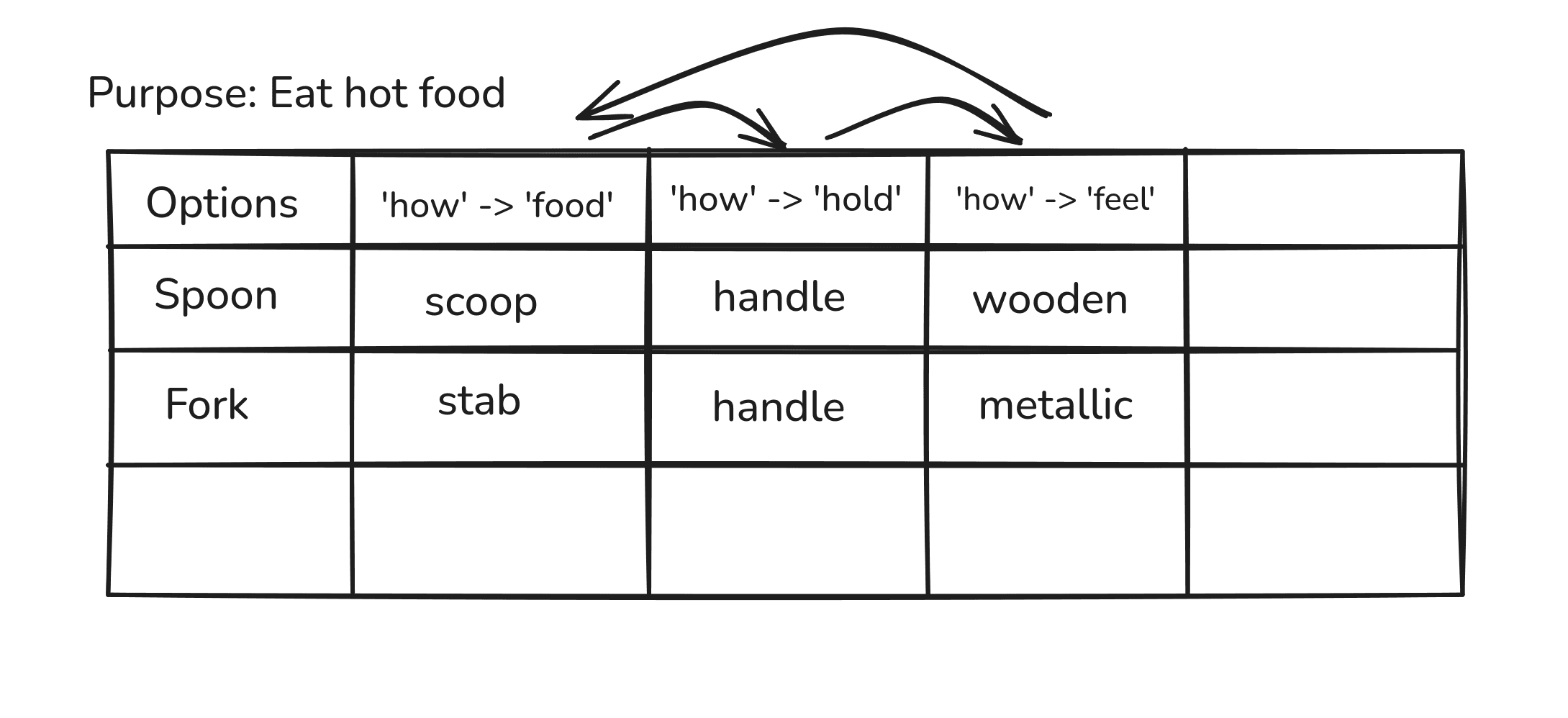
Engineers use a similar technique when analyzing a problem and its solutions (they call it morphological analysis). They have specific rules and conventions for how they do it but an expert copywriter is only concerned with what they can perceive. That perception changes over time and so they routinely update their observations. The advantage of using a tool like this is that we get some interesting ways of playing around with positioning.
Let's give the ordering of the columns some meaning. Let's say going from left to right means going from most important to least important, however that's perceived by the copywriter.
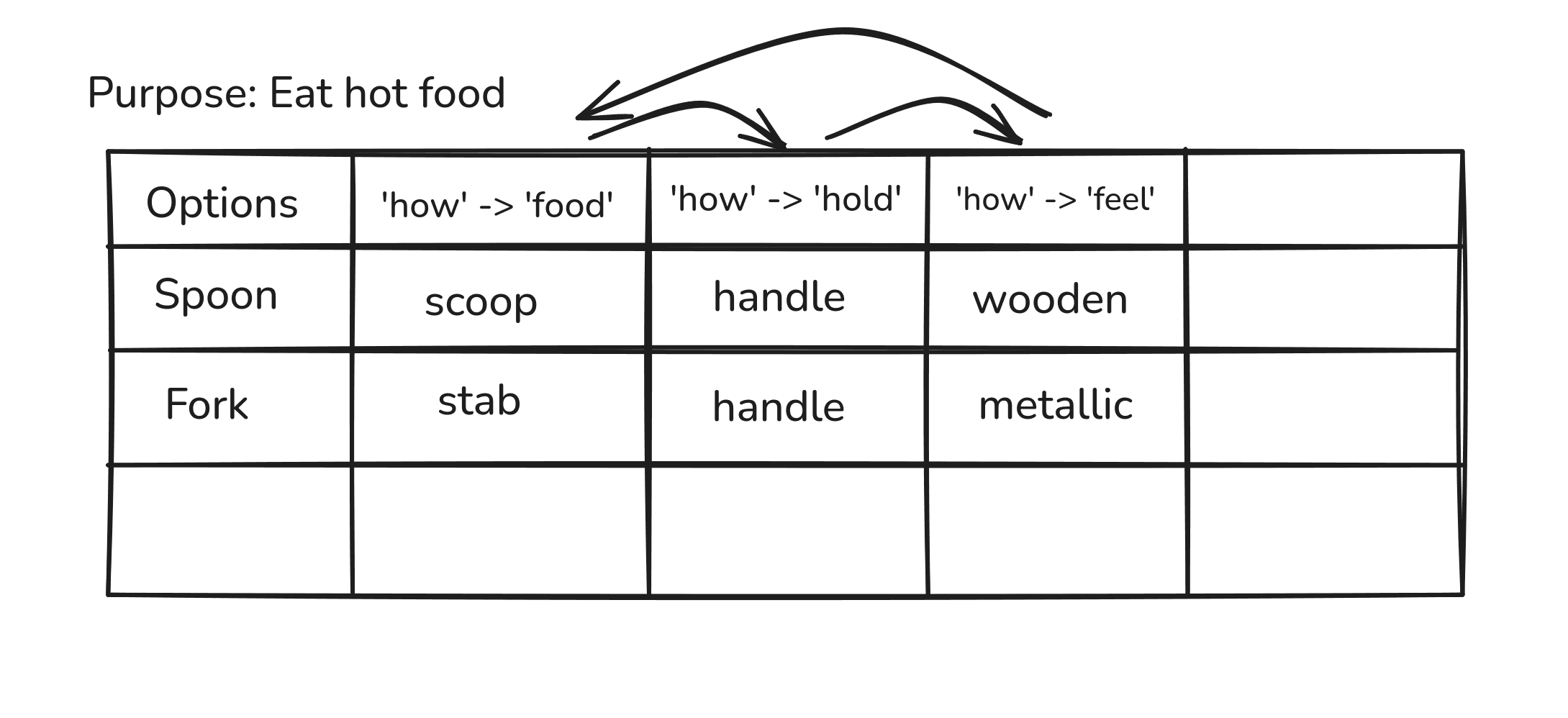
Here we've made explicit that the relationship with the food is the most important differentiating property between the options.
But what does this kind of structure give the expert copywriter? It allows them to experiment within a position.
For example, what happens when you add a new column?
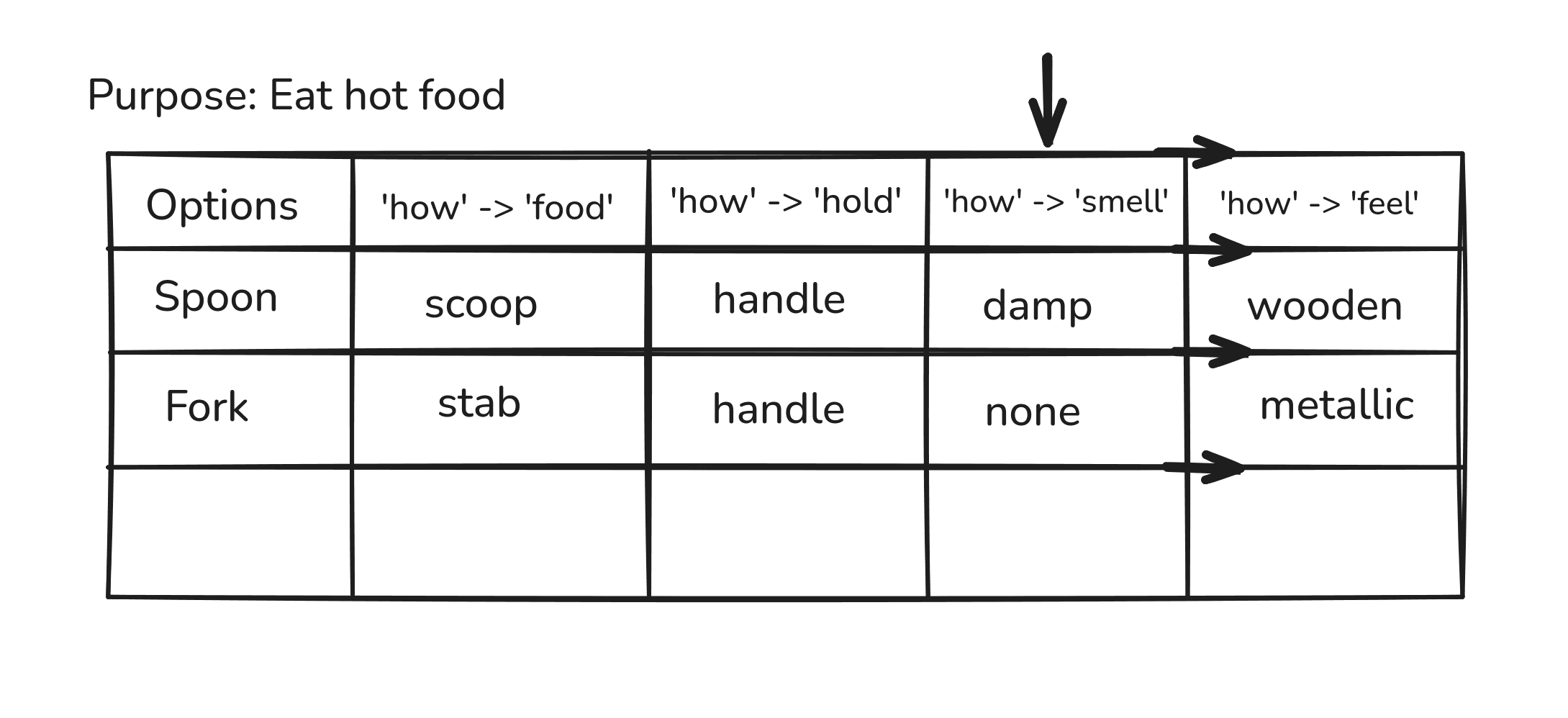
A copywriter can see that it's a new measurement, a new way to measure an option. But also how important it is towards a purpose, relative to the other columns, based on the column positioning.
And what happens when we figure out a new value in an existing column?
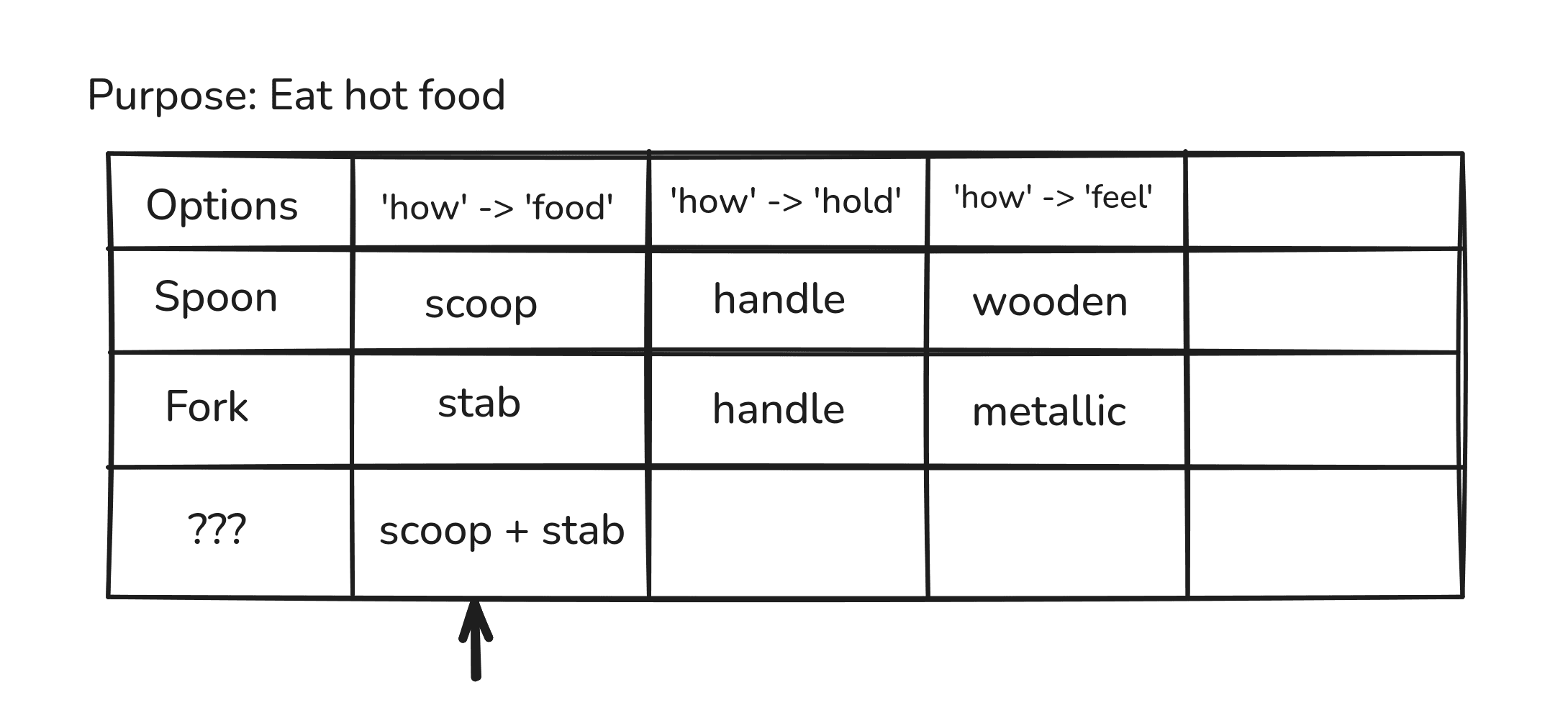
By experimenting with values in an existing column, a copywriter can see that it's a new way an option performs. And how would that affect its ranking in the list? This is how we may re-rank options:
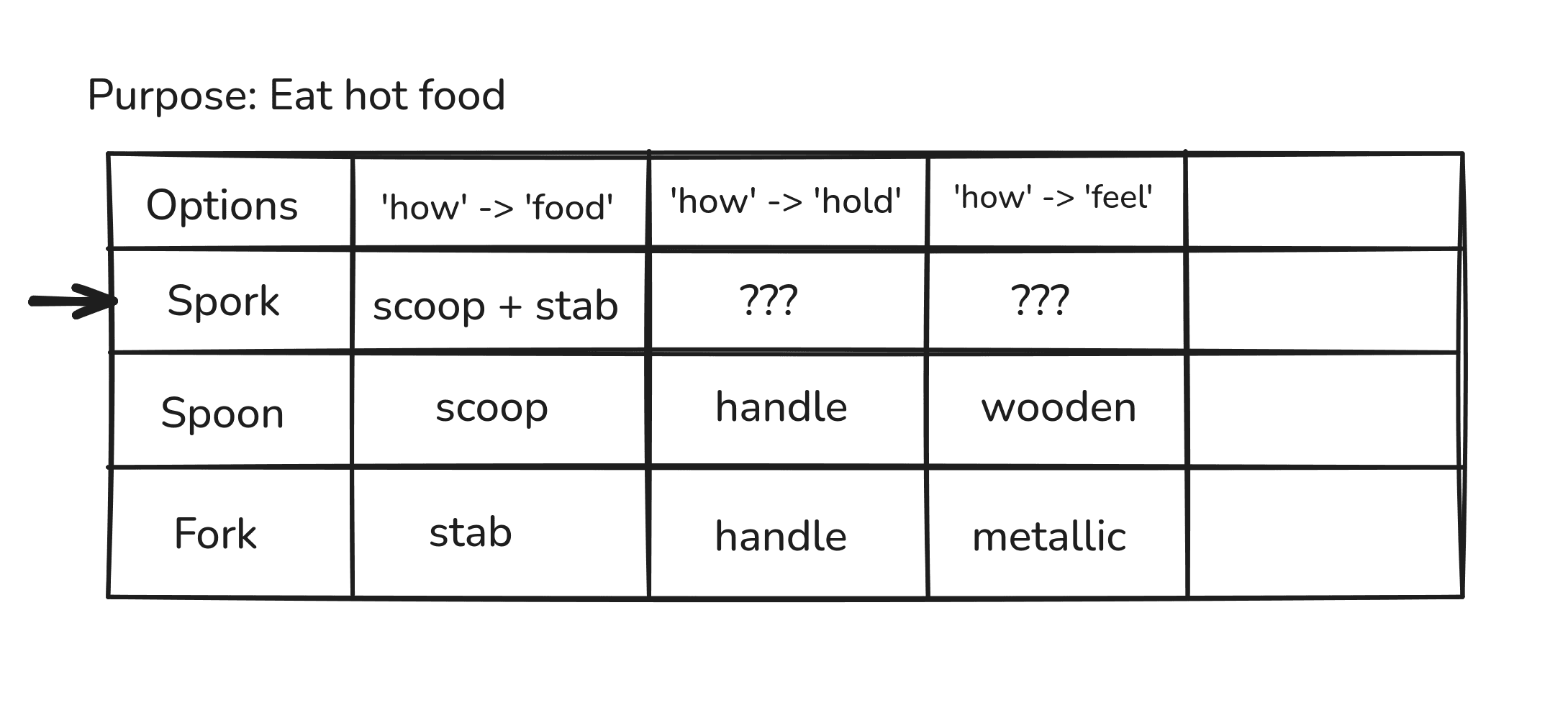
It's fun to play around with the options. And finding options is what an expert copywriter does.
Now, back to our fork salesperson. Unfortunately they don't currently have the ability to change anything about their product. They also realize the purpose isn't as specific as it could be. They update it to reflect what they're observing:
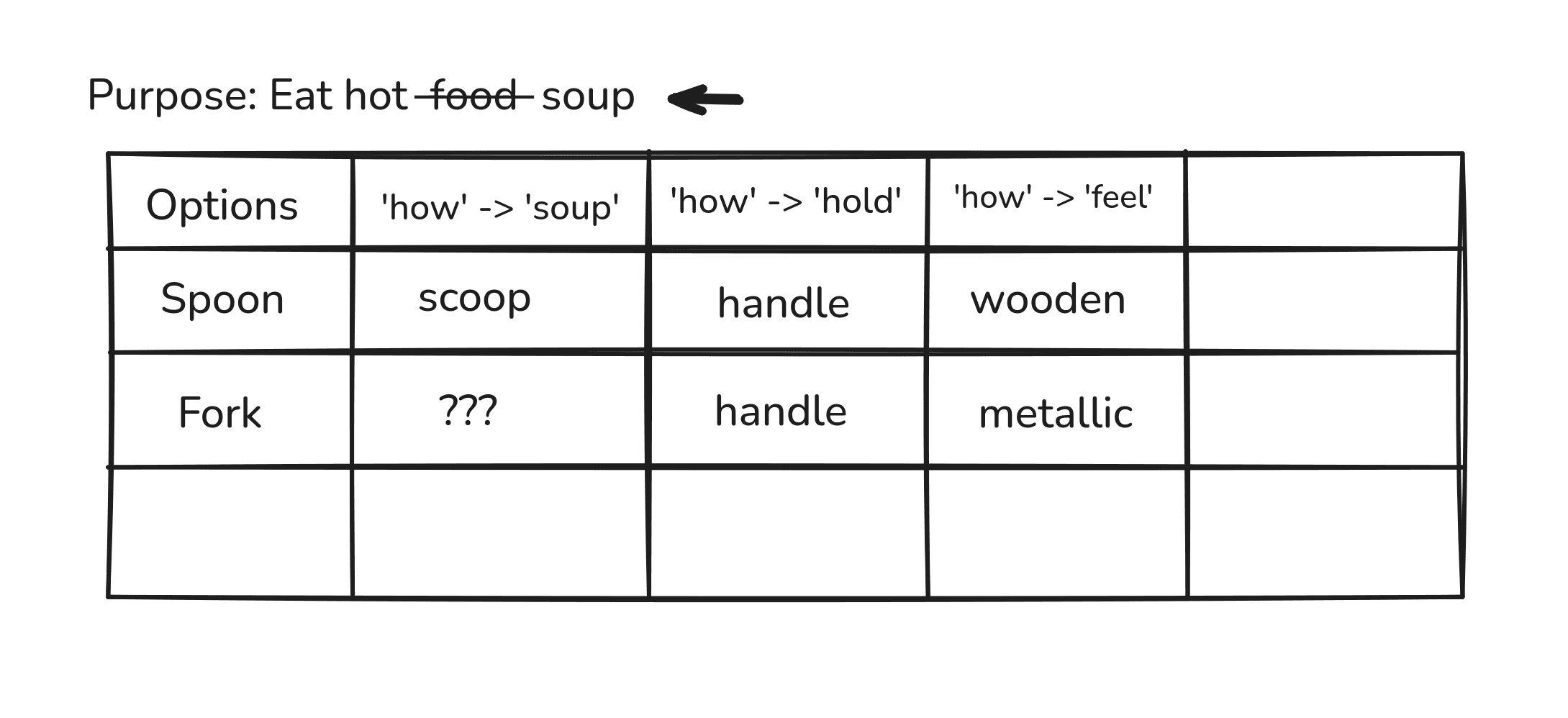
This now reflects their observations. The fork is ill-suited for the purpose they're focused on. No matter how many new columns they add or values they change on the right, if the left-most column is immediately dismissed, there's nothing they can do in this position. They're not going to be able to make a sale.
The expert copywriter comes to terms with this fact because it's a fact of business: a terrible position is often born out of constraints, not just bad decision making.
But however immediately obvious the defeat, the expert copywriter does not immediately accept.
§04
Finding a new position is finding a new purpose
The fork will never beat the spoon for the purpose of drinking soup.
The expert copywriter can't do anything about that, and so, they ask themselves the question that allows them to do something else: 'what's under my control right now?'
Our fork salesperson can't leave without money. The current inn they are at is the only market they have access to and the salesperson only has forks.
The location and the forks are held constant. They're unchangeable. So, the expert copywriter asks: What else is happening at the inn? What other purposes can the forks serve?
Our fork salesperson looks around.
Kitchen staff are opening cans with a knife, bending them while using them as a lever. Our fork salesperson goes over and looks at how they're doing this.
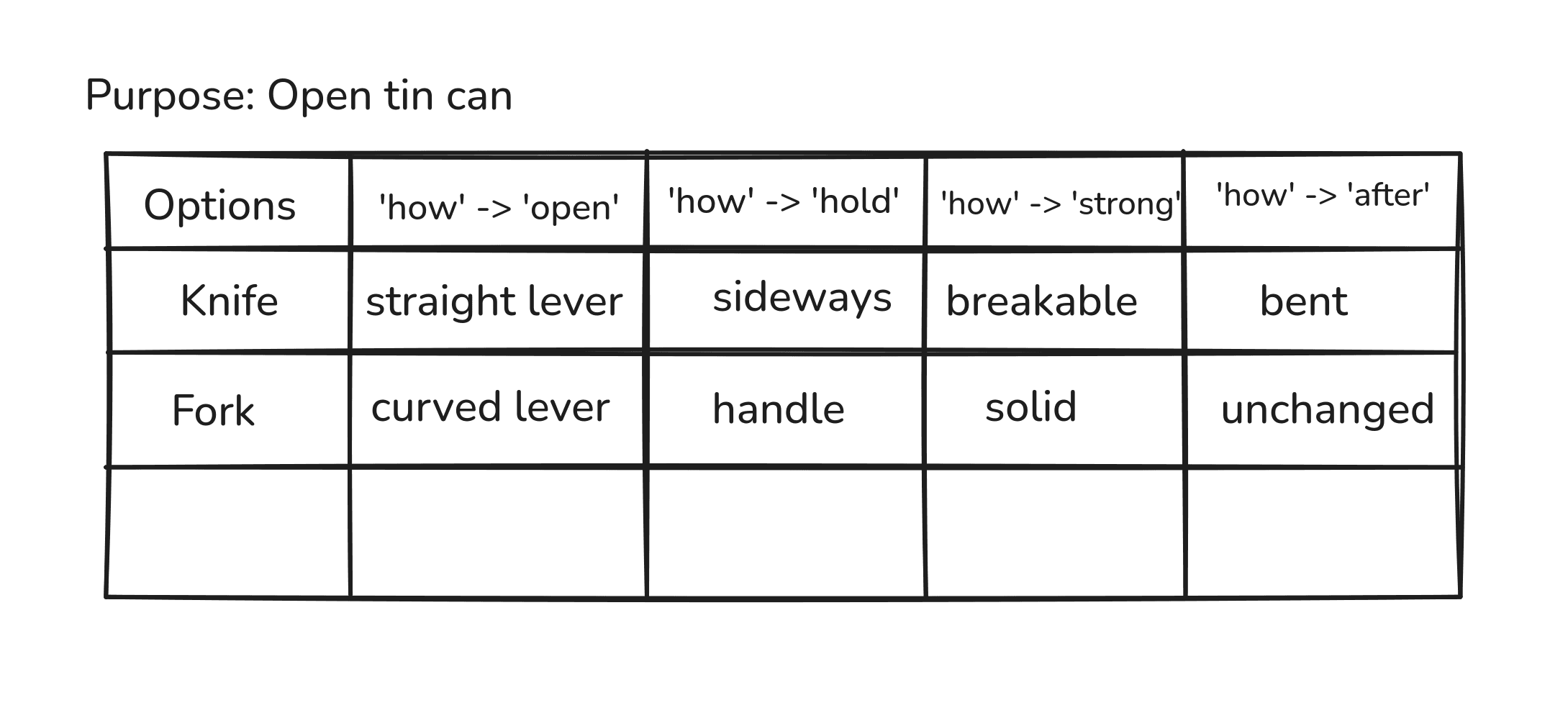
Our salesperson shows them how a fork makes it easier. The kitchen staff buy a few forks off the salesperson. Not as many as he would have liked to have sold, but more than zero.
Our fork salesperson spots a table of travelers at the inn. Some of them using twigs to scratch themselves under their socks and shirts. Our fork salesperson chuckles; anything will do at this point. He goes over to them.
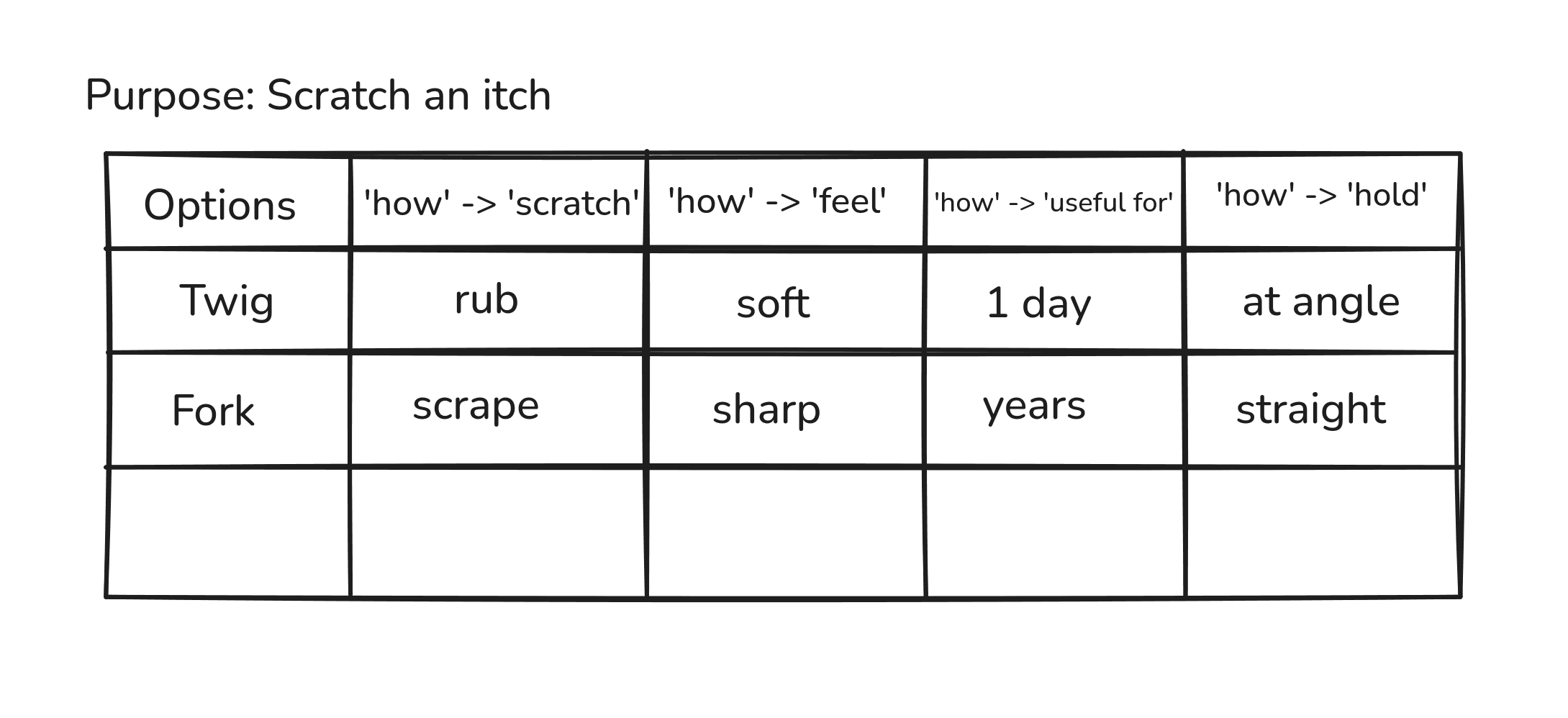
The travelers buy a few forks. For the salesperson, total earnings for the day are way off the ideal, but more than nothing. Enough to get to a better position tomorrow.
Outside of a marketing textbook, these kinds of situational constraints are very common. You don't always get the ideal position even if you can spot it.
The expert copywriter learns to make the best of a bad position and focuses on finding some results within a deadline. They find a way by focusing on what they can control.
§05
Sometimes you get to create a new option in the market
This spreadsheet like approach allows a copywriter to see what they're working with and what options they have. They can answer questions like whether to change positions (when stuck), how to compete within a position (when bested), and how to create new positions (when blessed).
Competing with other similarly positioned options is out of the scope of this excerpt. For now, let's look at another quick example. This one is less constrained than for our fork salesperson.
Say an entrepreneur at the village observes all these salespeople going from village to village, all in the hopes of selling their wares.
Our entrepreneur observes that they are either disheveled from the walking between villages or struggling to find cheap accommodation after sundown.
The expert copywriter tries to see how things are positioned currently.
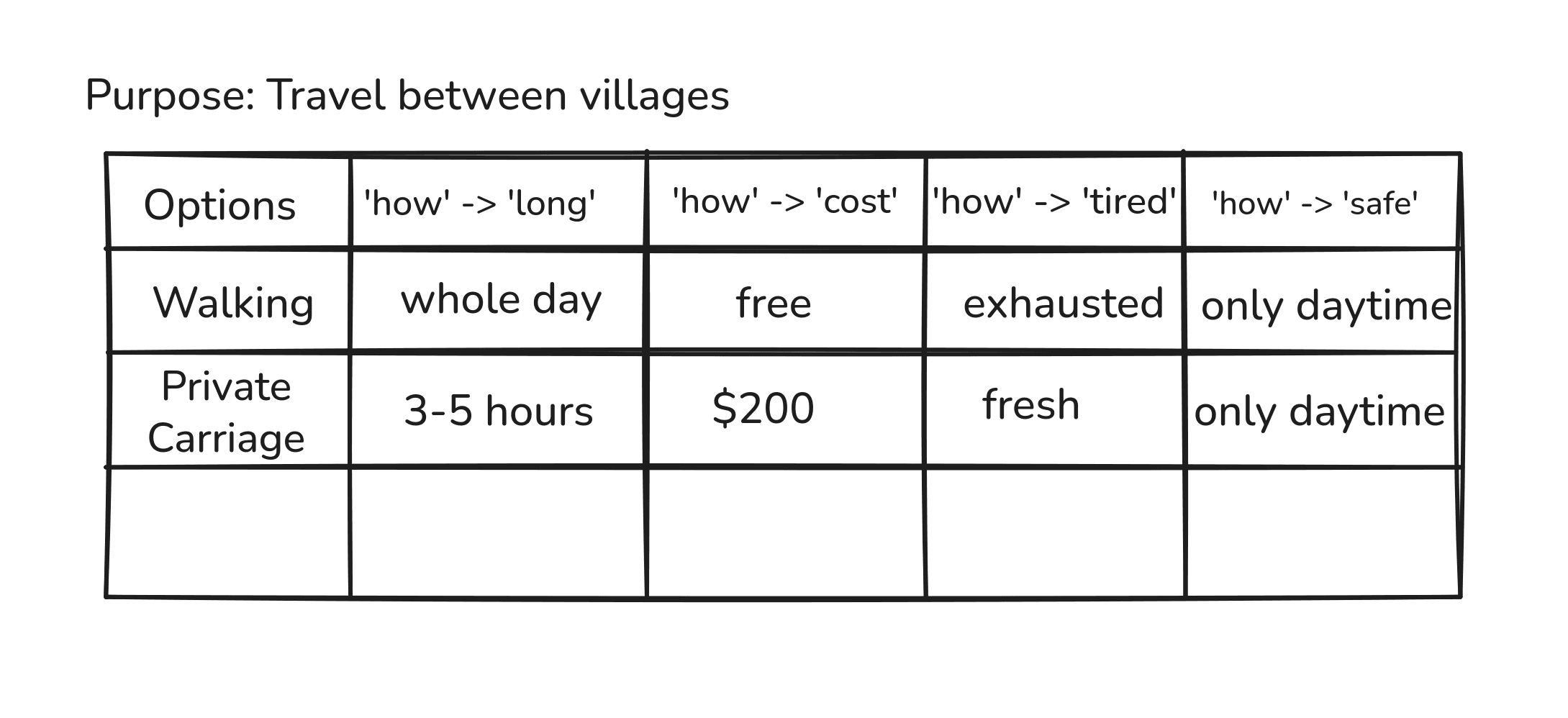
The entrepreneur has an idea for a new offering. The expert copywriter sees how it compares (and of course, gives the new option a name).
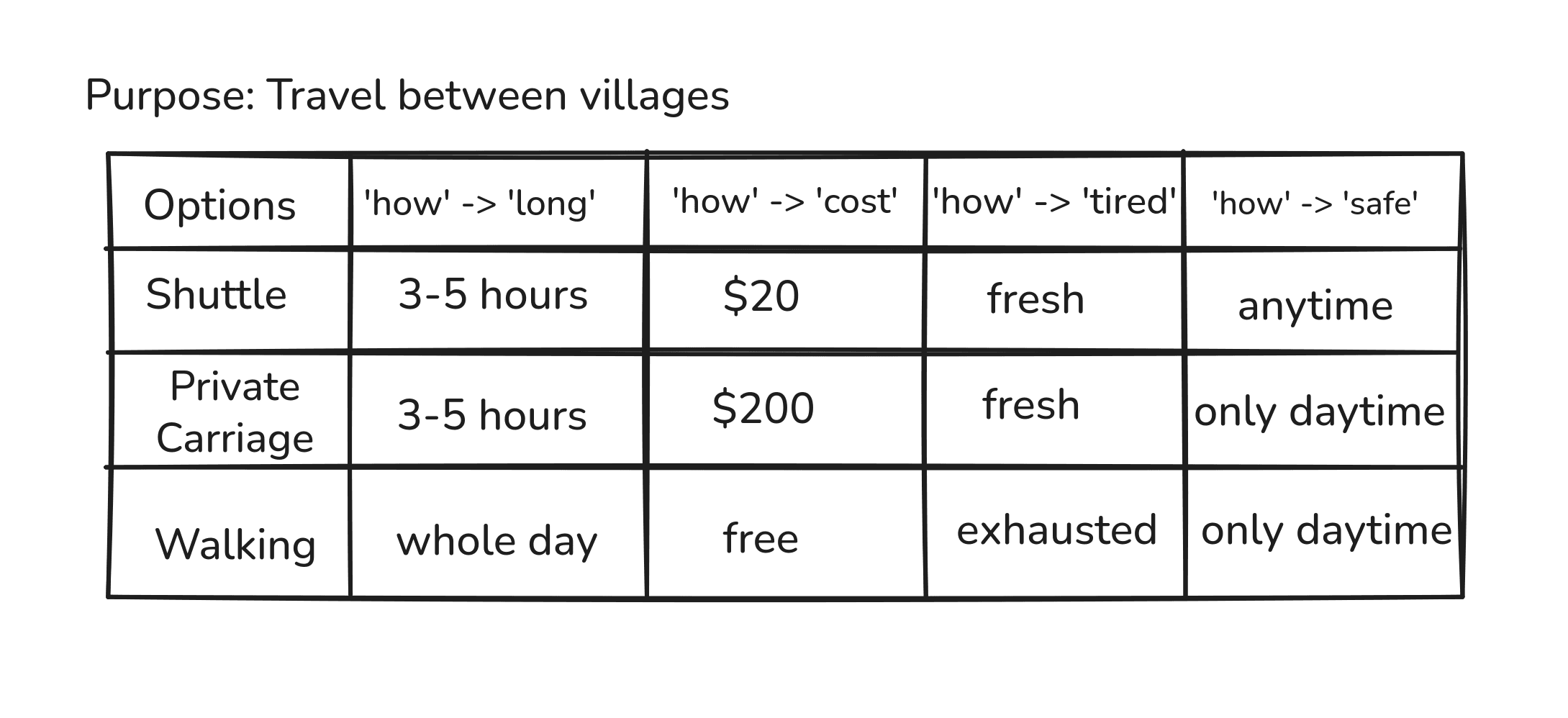
At this point there are no guarantees that it'll work as an option, but there is a sense of why it might or might not. Notice how we could've arranged the columns differently, giving a different weight to each observation. As a copywriter learns from a market, they continuously work on their understanding. This allows you to make your understanding of positioning explicit and see how it changes over time.
§06
Rank yourself in a list of options that serve a purpose
The core idea here is that an expert copywriter approaches positioning by observing, naming, organizing, and tweaking. If they stopped at simply using an intuitive sense of "be unique" as a solution to differentiation and positioning, then they wouldn't be able to quickly generate options when things don't go their way. That possibility of being wrong about what a good position or good difference is, is why an expert copywriter makes things explicit.
You don't even need spreadsheet software to do something like this. You can use a notes app, a piece of paper, anything that allows you to organize and sort your observations. The main benefit of the spreadsheet (or matrix) is that you can visually see gaps in performance or measurement. In some ways, it allows you to visually spot a gap in the market. But I won't stretch that metaphor too far.
§07
How do you explain your position to someone?
Now, how do you explain all of this to a buyer?
Say you did all this research, came up with something that should be better in theory, and now have to explain it to someone who hasn't done the research and analysis that you've done? You have the advantage of both knowledge gathered and time spent. How are you going to get them to see things your way?
Worse, what if your competitors look so much more attractive than you? What could you even say to someone already convinced by another option? Give up? Rue the market for not catching up with you?
The expert copywriter cracks their knuckles. They don't mind a fight.
- I write about how we can use language to make things happen.
- I have no fixed writing schedule.
- And I reply about ..uhhh.. 30% of the time.
Also, I love you. Maybe. Very lightly.

Notes
Note 1
This is an adapted excerpt from my book Copywriting after AI