Why you shouldconsider sendingearnest spam
- Tuhin Nair10 min read

Let’s start lightly: imagine you’re a colonizer.
How do you show up unannounced to a land where people don’t look like you, talk like you, think like you, and probably, dislike you?
And more importantly, how do you stop them from killing you?
Because they definitely want to kill you. People, tribes, nations, all hate unsolicited visits from strangers.
It’s a difficult question. The best colonizers used kidnapping and subterfuge, but even then, at some point they had to come up with ways to bridge a gap between people who don’t like or trust them.
But we’ll come back to colonization in a minute. Let’s go to the year 2003 for a second.
In 2003, 80% of Americans said they were bothered by the deceptive content of email spam.[1] Later that year, California took the charge and heroically said (in my words) “You absolutely need to ask permission first! No more sending commercial emails without getting consent.”[2]
But then, right after, a federal law (meaning at the national level) was passed (overruling California’s state law) saying unsolicited commercial email is fine until someone complains about it. You don’t need to ask for permission first.[3]
What? Why? Everybody hates it! Even if we ignore all the money and lobbying and technical problems for a second, what narrative could possibly justify this when everybody hates it?
They used (in my words): the underprivileged.
They said that (in my words) if you have no money and no connections you need inexpensive ways to seek out commercial opportunities.[4] They claimed that it’s a fundamental freedom of speech we must maintain for commerce.[5]
And yet, do you know who refuses to use this channel because it’s been abused by marketers and scammers to the point of universal, moralistic disdain?
The non-malicious underprivileged; those seeking fair opportunity with no money or connections.
Spammers have abused the system to the point where those who depend on it feel like they’re doing something wrong by using it.
So, in this post, we’ll see how a well-meaning person can use unsolicited email to connect to existing networks without having any preexisting connections or money (and how to do it right when everyone hates it).[Note 1]
But first: why does spam need to exist, even if it’s so hated?
§01
Sometimes you get pulled by a network; other times, you push into it
For idiot’s sake (yes, yes, my sake), let’s say this is the economy:
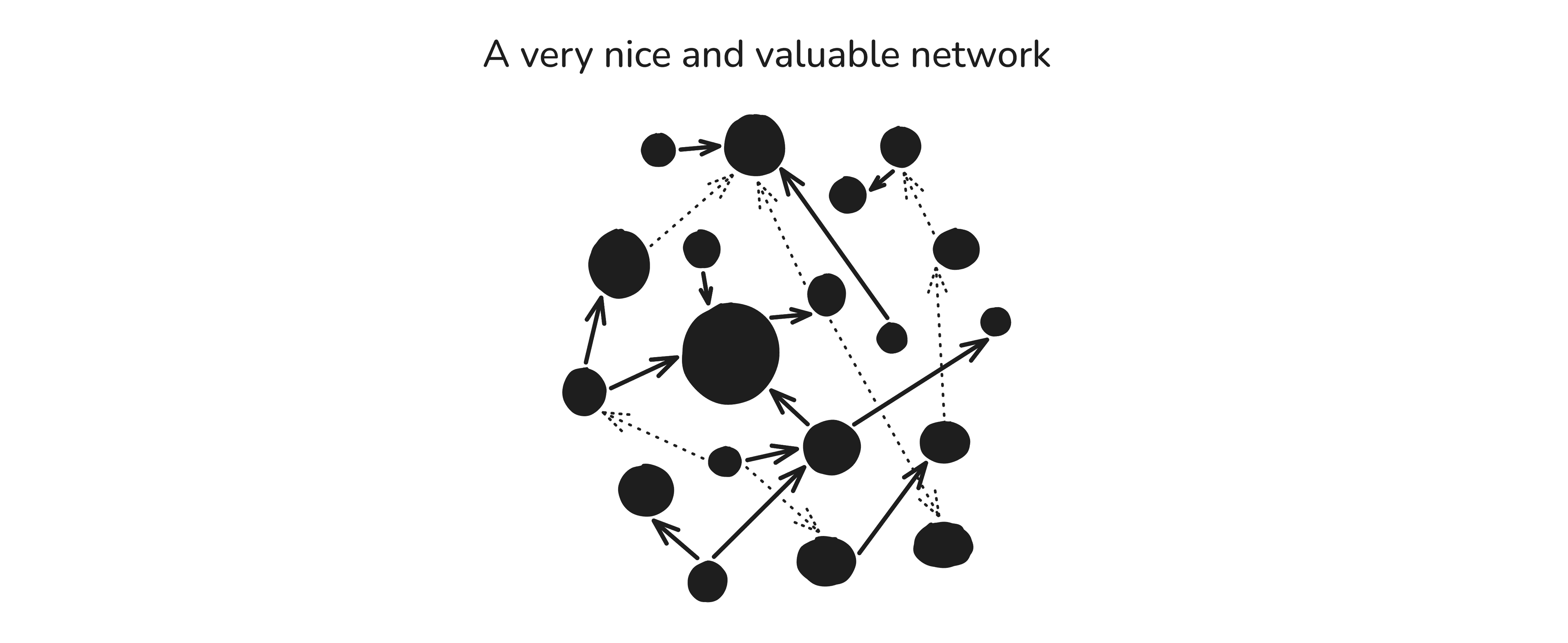
For some, if you were born well, we could place you here, already connected to the network:
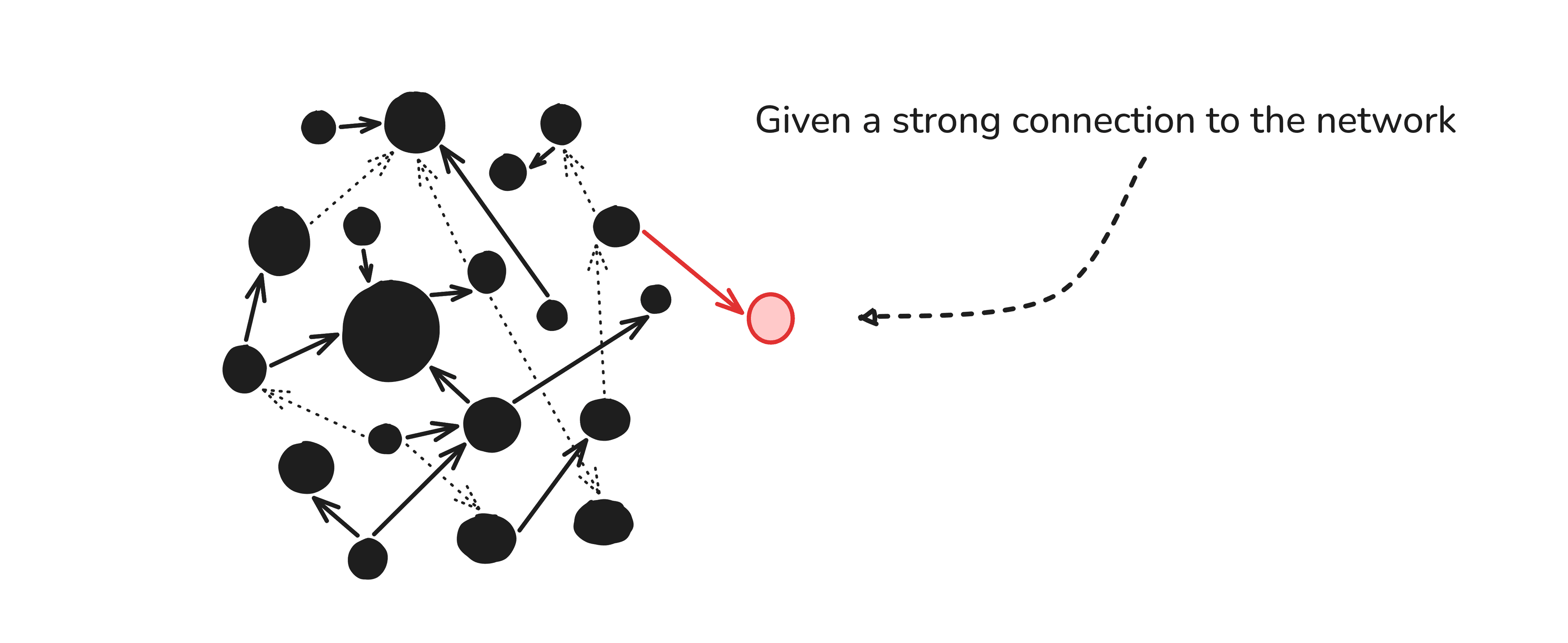
For most people, if you’re smart, stable, hard-working, and lucky, you could work your way through a prestigious institution and become somewhat well-known:
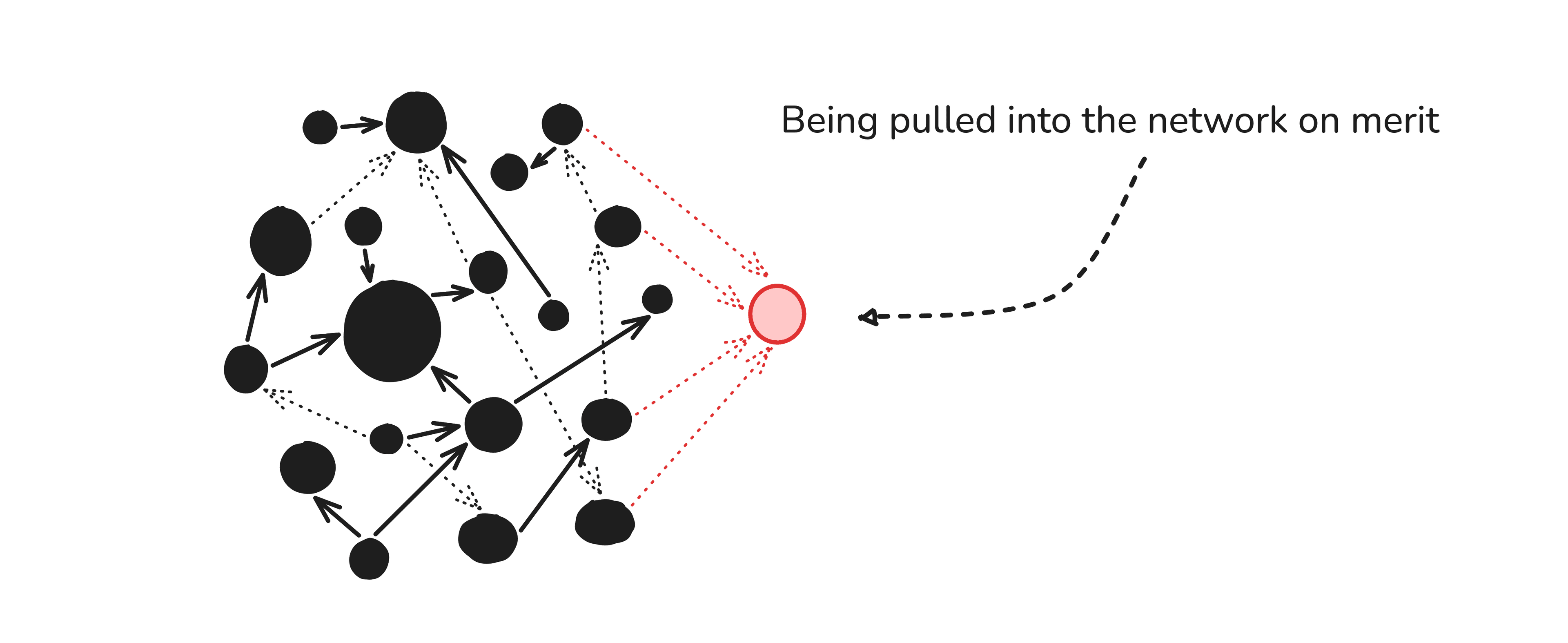
That’s about as meritocratic as the world gets. We rely on certain institutions for determining merit, and if you can get into them, they’re your best bet for joining the economy.
The better your institution, the better your merit, and the stronger you’re pulled into the network. It works well.
But the number of institutions, and their capacities, are limited. There’s a limit on how many people can go through them at once to attain this clear proof of merit.
So, what happens if you want to be a part of the network but you find yourself in a position with no pull, with no preexisting connections, or in a weak institution, or with no institution at all?
You, unfortunately, float.
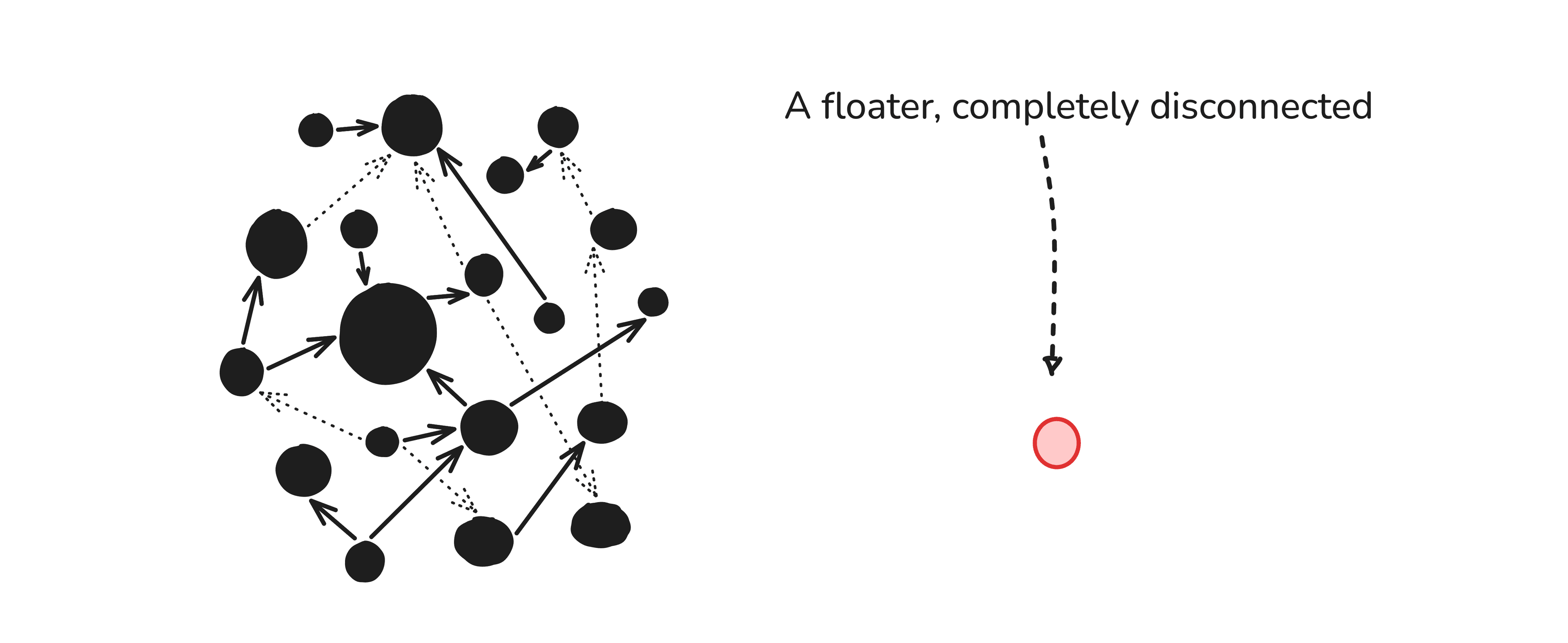
Still, if you can afford it, you might be able to advertise yourself into visibility, hoping people will eventually pull you in.
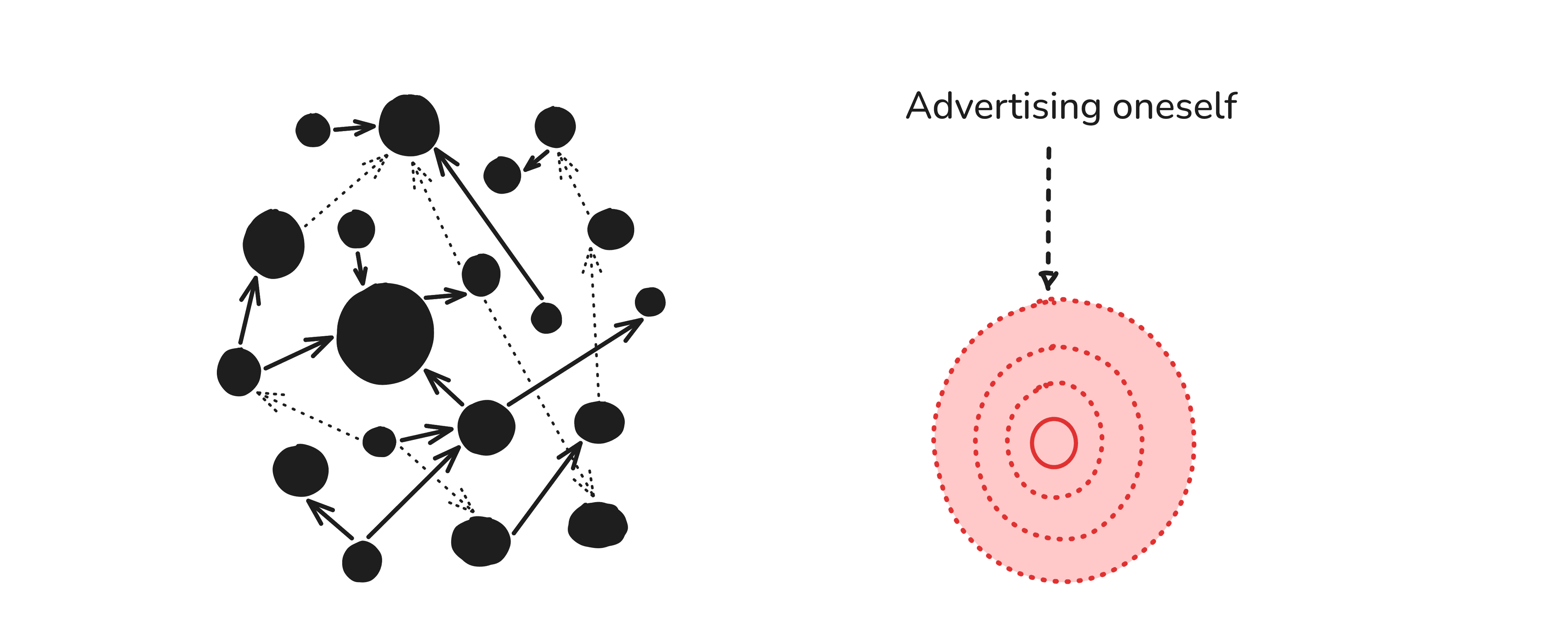
But what if you don’t have the money to pay for visibility?
Well, that’s one of the arguments (earnest or not) made by the lobbyists for allowing unsolicited email to be legal.[6] When people are in a situation where they have no pull into a network, we need to preserve their right to try and …
… push into the network.
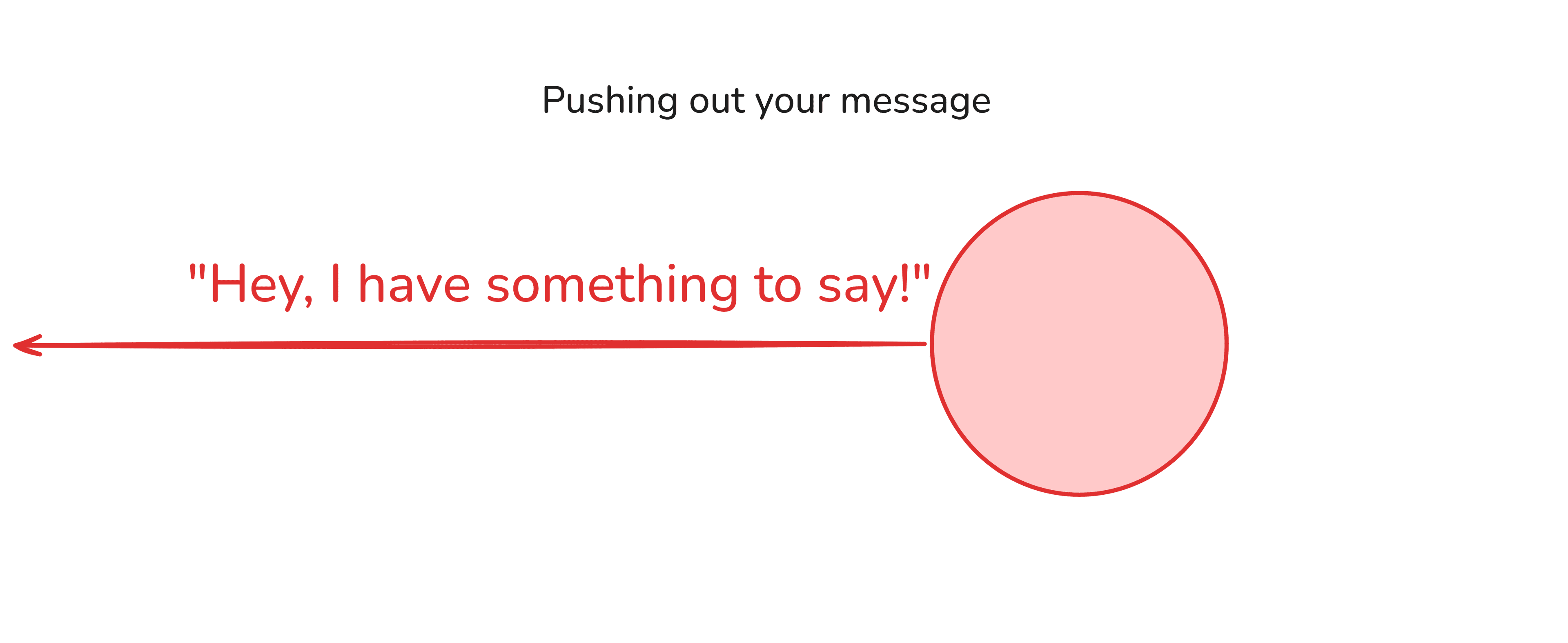
Push or pull. Those are the only two ways, in nature, that messages travel between communicators. Either your message gets pulled by the network,
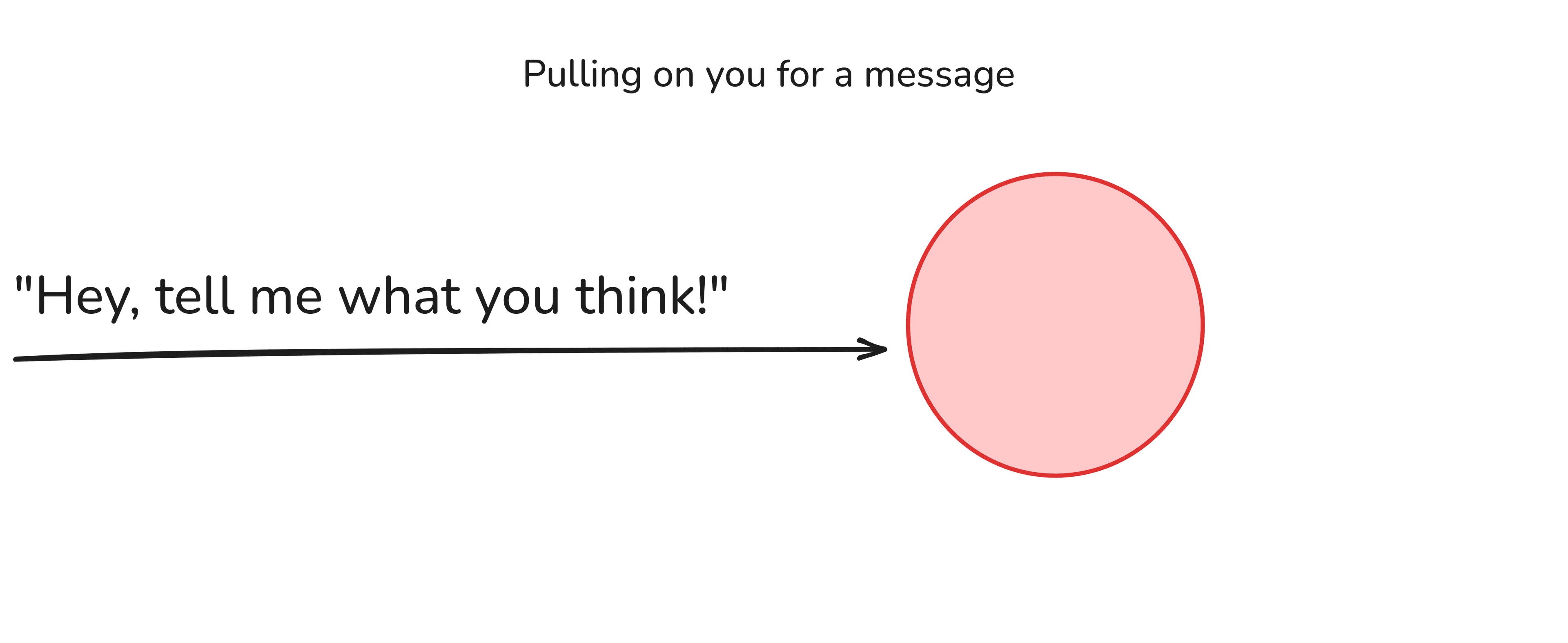
or you push your message into it.
But the network, quite rightly, doesn’t like people trying to push too hard into it. This is what happens when someone abuses pushing:
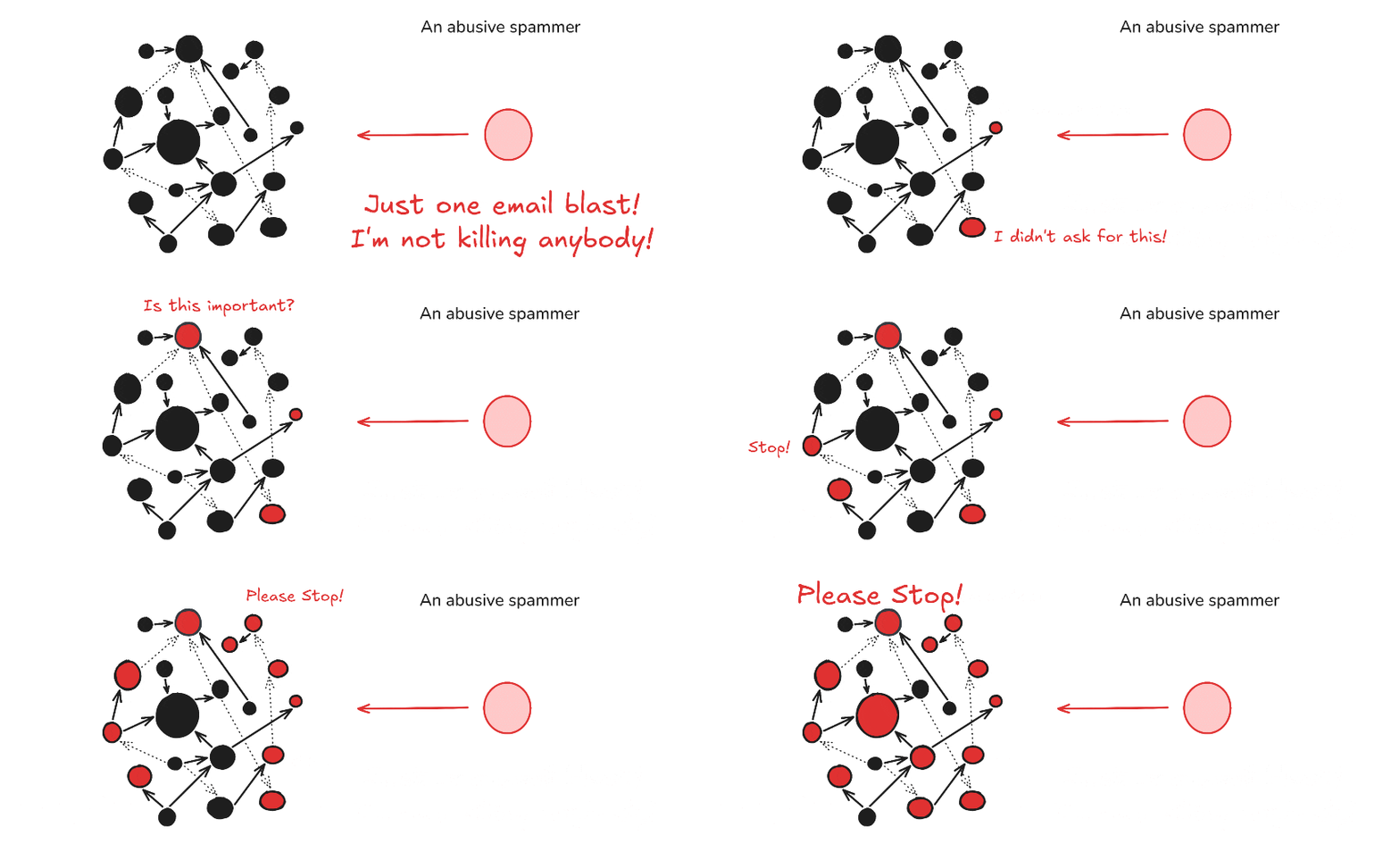
A single unsolicited message (still called spam) is not the real problem. What makes it abusive is when an unsolicited message is broadcast onto a network. A single message, created once, can be sent to everyone in the network, forcing everyone to individually deal with the message. And now, creating and copying a message, using phone or email, is very easy. So, people who don’t care about the members of the network can easily and cheaply abuse everyone’s time, space, and attention.
This is the spam we know. This is the spam we hate. This is the spam the legislation was trying to deal with.
Some countries, like Germany and Canada, try their best to make it as difficult as possible to push into the network.[7][8] In both those countries, similar to what California tried in 2003, you need to ask for permission before you can send someone a commercial email. This is an opt-in system.
The US (and large parts of the world, really) has an opt-out system. The members of the network have to complain after someone bothers them; they have to opt out after being annoyed.
Now, even though I make my money as a marketer, I love the opt-in system. It makes for a better world where people can have more trust in the messages they receive. It’s, in my opinion, better for most people.
But what if you asked a struggling German entrepreneur how they feel? They either use loopholes in the system that stretch the semantics of what ‘permission’ means, or they accept the extra delay and tedium of the opt-in process, all while trying to create economic opportunity from scratch.
Or what about the Canadian marketer who risks hefty fines for reaching out to people without sufficient documentation? Especially while international competition ignores the rules because of how annoying it is to enforce laws across borders.
They may not necessarily agree with my preferences.
In any case, whatever the trade-offs you prefer, notice how we cannot legislate ‘push’ out of the world, but only make it harder to do. ‘Push’, which is people exploring and probing and trying for connection, will always exist and will always be annoying to either control or receive.
So, is ‘push’ a fact of nature that’s only fit for abuse? What if you could use it to join a network that’s otherwise inaccessible to you? How would you do that when everyone hates it?
Worse, they want to take your head off for even attempting it.
§02
Pay a price the abuser is unwilling to pay
A translation of a conquistador telling us about his experience of approaching (in a rather unsolicited manner) a foreign and hostile shoreline:
“…when we perceived their intentions we were on the point of firing at them, but it pleased God that we agreed to call out to them, and through Julianillo and Melchorejo [captured interpreters], who spoke their language very well, we told them that they need have no fear, that we wished to talk to them… we showed them strings of green beads and mirrors and blue cut glass beads, and as soon as they saw them they assumed a more friendly manner”.[9]
So, they carried gifts. That’s all? That’s the trick? Is that why marketers like sending useless-but-we’ll-pretend-it’s-not “gifts”? No, there’s got to be something more fundamental here.
Let’s look at one more example: imagine you’re a tribesman in the past struggling to find a wife in your village.
Now, if you look anything like me, this is an even harder problem than colonization. But you, being the dreamy romantic that you are, decide to go looking for a wife in a few other villages.
The other villages don’t know you, though; you’re a stranger to them. So, they might need you to do a few things to prove yourself worthy of their attention.
One village might light a fire and ask you to walk through the smoke.[10] Another village might ask you to drink a few cups of a mouth-numbing concoction.[11]
And you’d probably do it, you loveless booboo.
Ah! And there’s my point: you have to pay a price to prove yourself worthy of attention. Bringing gifts, enduring something slightly uncomfortable, taking effort for no guaranteed gain, are all prices people pay to signal something very specific.
Earnestness.
And earnestness matters because dangerous, selfish, malicious people exist in the world. And when it’s hard to distinguish between a dangerous person and an earnest person, the earnest person needs to pay a price to signal that they are earnest.
But there’s something imperfect about these signals, isn’t there? The colonizer did go on to colonize. And a sweet-seeming, smoke-walking stranger could turn out to be a liar. They’re imperfect because those gifts and rituals are weak signals of earnestness; they’re easy to fake.
Weak signals of earnestness are the weapon of deceptive abusers. They do the bare minimum to appear earnest and nothing more. If we want to make it clear we’re earnest strangers, we need to pay a price that a dangerous person is unwilling or unable to pay.
For unsolicited email, that signal used to be doing good research and analysis. If you made thoughtful observations and took the time and effort to write out your analysis, your long email was a strong signal that you took thoughtful effort to appear earnest.
AI—sort of—ruined that. It can research and analyze (even if not profound), and now, abusive spammers use it to send unsolicited emails. Things have switched! A long, wordy email is now a signal that this email might be low-effort or malicious.
That sucks for us! Being thoughtful now is harder to display because AI can mimic it so cheaply. So, what’s a good Spamaritan to do? Do we not have any strong signals left?
I promise to update my answer when we perfect humanoid robots, but until then, here’s my answer: offer real-time personal interaction.
An AI can’t yet do it. And an abusive spammer would rather not.
It doesn’t mean people will want to interact with you; most strangers are still scheming and dangerous. But it does tell people something about your earnestness; it does offer them something enticing, the fact that there might be an earnest person looking to spend their time with them.
Offering real-time personal interaction in an unsolicited email gives you a chance, a tiny chance, of connecting to a new network. There’s still risk of not being welcomed, and you should expect hostility, but still, I think it’s a risk you should consider taking.
Because there are ways to do this without anyone getting hurt.
§03
30 second guide to making connections using email
Step 01: Get a professional looking domain for sending email.
Even if you have only good intentions, there’s a risk of people complaining (which is their right), so pick a sub-domain on your existing domain or a new domain that you don’t mind losing.
Step 02: Find professional email addresses.
You only need a handful. Some people have their professional email listed online, but if pressed for time, you can buy the few you need as long as it’s not a personal email address. (marketers use companies that sell email addresses to buy them in the 1000s; you only need a handful; ask your favorite LLM for instructions; just make sure it’s not a personal email address).
Step 03: Use an LLM to check the laws of the country you’re in and the countries you’re sending email to.
Double check by reading human-written explanations on the web.
Step 04: Send short emails that describe your situation and lack of connection.
‘Who you are’, ‘What you’re doing’, and ‘How you’d like to interact’. Nothing else! No observation, analysis, links or questions, nothing. That’s done now; with everyone expecting AI, it only weakens your message. The offer for real interaction is the most important thing about your email.
Offer to meet the engineering managers at your favorite companies for coffee. Offer to chat with VCs for their thoughts on a video call. Offer to ask your favorite writers about their process on a phone call. Offer interaction! The world is sick of being sold to, of being pandered to, and you don’t need to do any of that. Just interaction for connection’s sake is extremely valuable. It’s your signal. It’s our signal. It’s the signal for the ones who’re trying to connect to a network, despite the stupid bloody odds.
That’s it. This is my whole argument summarized:
The people who send the most unsolicited emails are not the ones who need it the most. If you have no network, are alone, have no money, no connections, no prestige, no institutions to climb through or on, then please consider sending some earnest spam.
Get porky.
- I write about how we can use language to make things happen.
- I have no fixed writing schedule.
- And I reply about ..uhhh.. 30% of the time.
Also, I love you. Maybe. Very lightly.

Notes
Note 1
I’m treating all unsolicited, non-transactional email, commercial or not, as spam. Because socially, if it’s unsolicited, it’s all spam.
References
- [1]
Lee Rainie and John Horrigan, “Spam: How It Is Hurting Email and Degrading Life on the Internet,” Pew Research Center, October 22, 2003, accessed May 20, 2026.
- [2]
California Senate Bill No. 186, 2003–2004 Reg. Sess., ch. 487 (September 23, 2003), codified at Cal. Bus. & Prof. Code § 17529.
- [3]
Controlling the Assault of Non-Solicited Pornography and Marketing Act of 2003, 15 U.S.C. §§ 7701–7713, especially § 7707(b), accessed May 19, 2026, Cornell Legal Information Institute.
- [4]
Controlling the Assault of Non-Solicited Pornography and Marketing Act of 2003, 15 U.S.C. § 7701(a)(1), accessed May 19, 2026, Cornell Legal Information Institute.
- [5]
Congressional Research Service, Regulation of Unsolicited Commercial E-Mail (Spam): Issues and Legislation, accessed May 19, 2026, PolicyArchive copy of CRS report.
- [6]
U.S. Congress, House Committee on Energy and Commerce, Subcommittee on Commerce, Trade, and Consumer Protection, Spam and Its Effects on Small Business, 108th Cong., 1st sess., July 22, 2003, accessed May 19, 2026, Congress.gov hearing transcript.
- [7]
Innovation, Science and Economic Development Canada, “Understanding Canada’s Anti-Spam Legislation,” Government of Canada, accessed May 20, 2026, Government of Canada CASL overview.
- [8]
“Act Against Unfair Competition (UWG),” § 7, translated by the German Federal Ministry of Justice and the Federal Office of Justice, accessed May 19, 2026, Gesetze im Internet (English translation).
- [9]
Bernal Díaz del Castillo, The Discovery and Conquest of Mexico, 1517–1521, ed. Genaro García, trans. A. P. Maudslay, The Broadway Travellers (London: George Routledge & Sons, 1928), 65, Internet Archive.
- [10]
Thomas, William. “Tanderrum.” Wikisource. Accessed May 21, 2026.
- [11]
“Guide to Drinking Kava in Fiji,” Tourism Fiji, accessed May 21, 2026.